The Vivarium Users Guide
Compose living models.
Vivarium is a framework for building multiscale biological models by composing independently-written simulators into one executable whole — and for turning the runs into auditable scientific evidence. It is built as two spines wired into a single discovery loop:
The computational spine
What runs. Typed Stores hold state; Processes and Steps wired to them carry the dynamics; whole simulations nest as Composites. Updates are deltas merged by the type system.
The agentic spine
What reasons. Each run is a Study inside an Investigation. Studies form a gated DAG; a code-computed evaluator rolls runs up into a verdict, a readiness score, and open epistemic debts.
Neither spine is the engine — the engine is the closed loop between them, and the Workbench is where the loop turns.
The four packages
Each layer imports the ones below it and never the reverse. Click through to any layer.
apply is the one law that merges deltas, so independent processes compose.
A Composite is the runnable object; a Study is the reason you run it; an Investigation is the argument several studies build together.
How it all fits together
Read the map bottom-up and it's a simulation; read it top-down and it's an argument. Every box links to the chapter that covers it.
Choose a path
New here?
Start with What is Vivarium? for the mental model, then Core concepts for the vocabulary.
Build a model
Go to Processes & Steps and Composites & wiring to write and run your first composite.
Do science
Head to Studies and Investigations to turn runs into gated, verdict-bearing evidence.
See the Start here guide for full step-by-step learning paths.
What a composed model looks like
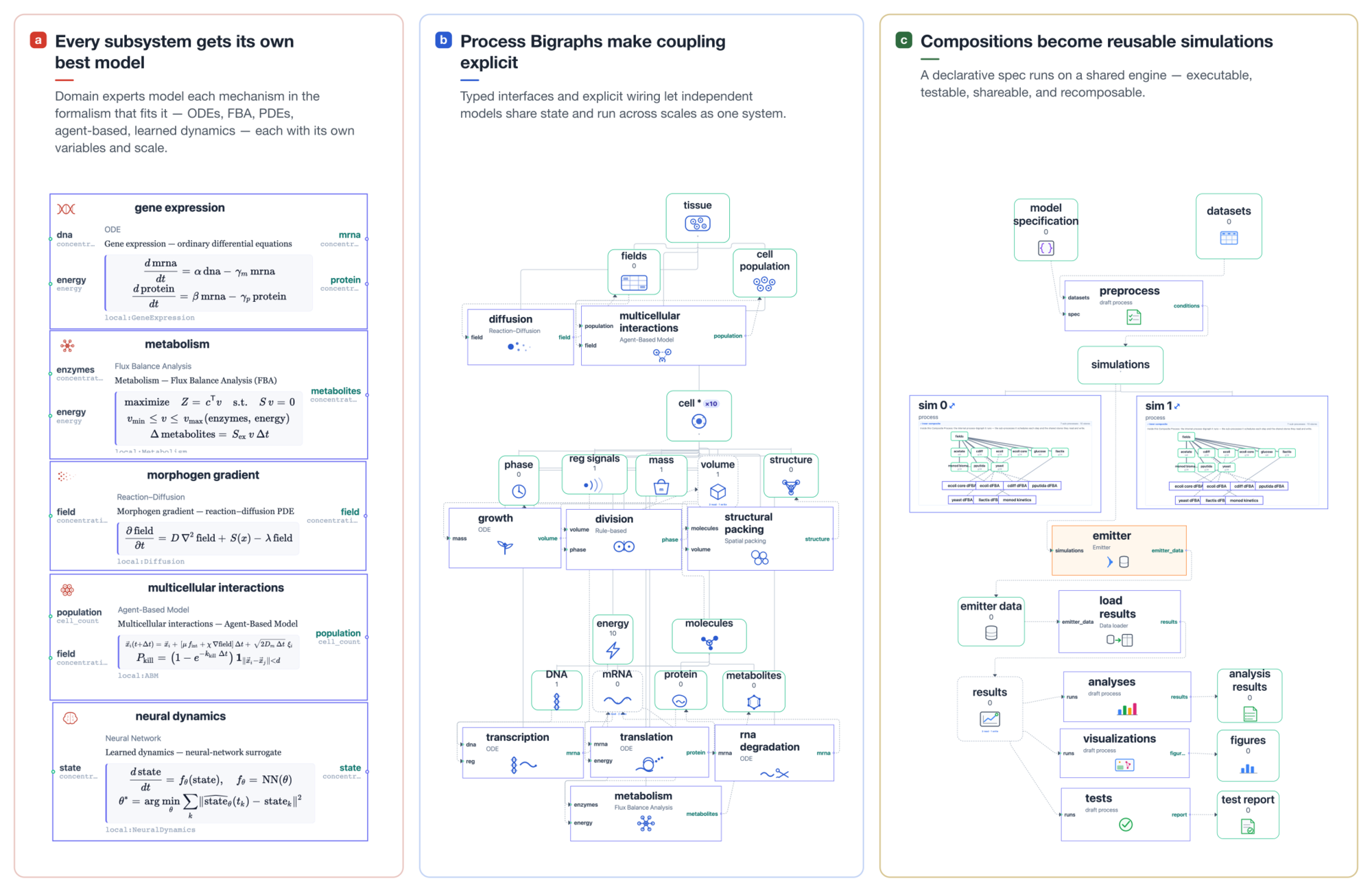
The Vivarium framework is described in Agmon & Spangler, Process bigraphs and the architecture of compositional systems biology (arXiv:2512.23754). Source packages live at github.com/vivarium-collective.